
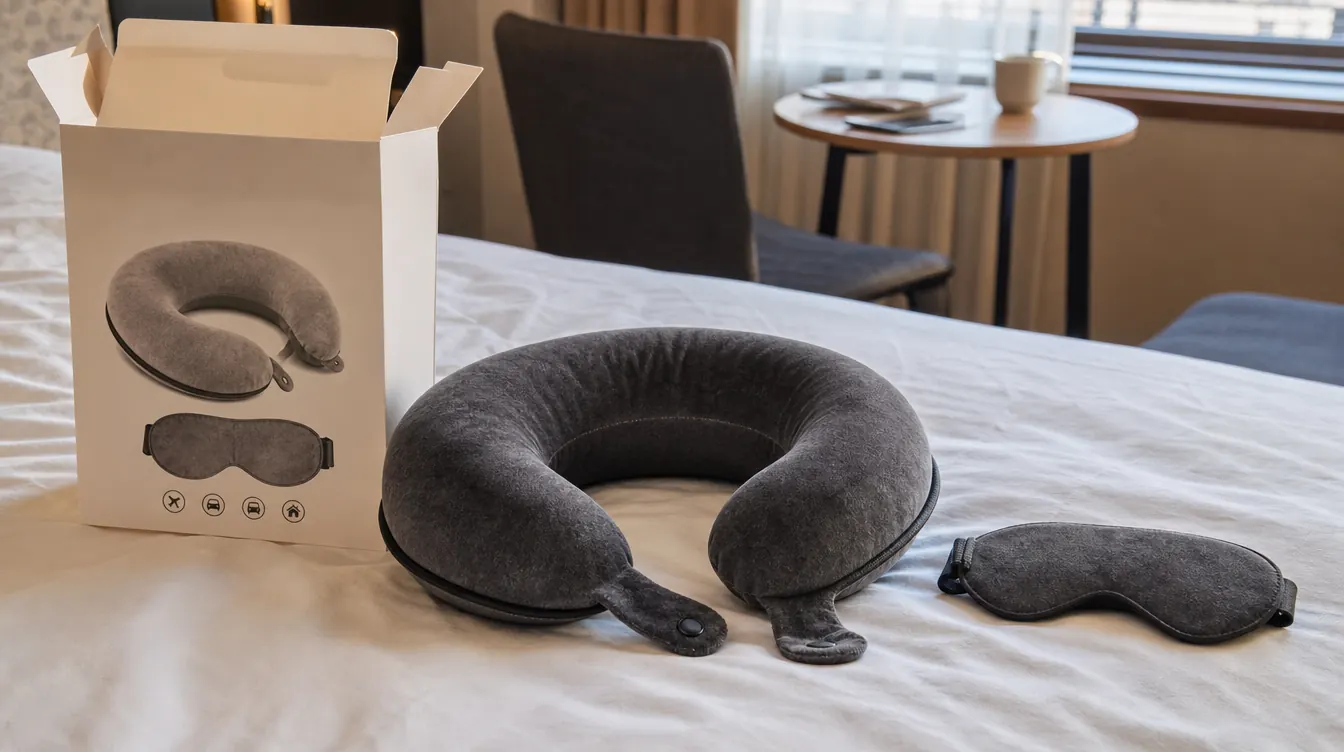
Type a travel neck pillow's name into Amazon and you get the same set of photos on every listing. Plush-looking foam, a model sleeping peacefully with their head tipped at some impossibly comfortable angle, a cover that looks soft enough to be a real bed pillow. None of that tells you what the foam actually feels like against your jaw four hours into a delayed flight, or whether the thing smells like a packing warehouse the first night you try to use it. This is the review that skips the glamour shots and gets into what the bullet points leave out.
I bought the MLVOC memory foam neck pillow kit after months of using a cheaper, unbranded pillow that had flattened out within a handful of trips. What I wanted this time was the version of a review that covers the first two weeks honestly, not just how a pillow performs after it has already broken in and every rough edge has worn smooth. Over several months of testing it across a mix of trip types, short domestic flights, one long-haul overnight, and a road trip where I wanted to see if it held up outside a plane seat entirely, a few things about this pillow surprised me in ways the five-star reviews never mention.
The Quick Verdict
Solid value for the price and a genuinely useful support once it's on your neck, but the sizing quirks, the out-of-box smell, and the firmness gap between the photos and the real thing are worth knowing before you order it for a trip next week.
Amazon Check Today's Price →Before you order the wrong size neck pillow for your next trip, read this.
This is the exact MLVOC memory foam neck pillow kit covered in this review, eye mask and earplugs included. Check today's price and current availability on Amazon before you pack for your next flight.
Amazon Check Today's Price on Amazon →How I Tested It, Warts and All
Instead of one person using one pillow for a stretch of trips, I ran this test with three different people, on purpose, because a lot of the complaints buried in the Amazon reviews had to do with fit and neck size rather than how the foam holds up over time. That angle already has a solid answer, we already put together a full year-long breakdown of exactly how this same pillow wears in over repeated trips. What was missing was an honest look at what happens in the first few uses, before the foam has softened and before you've decided whether the fixed clasp actually fits your neck.
The test ran across five separate trips over four months, spread between the three of us so the pillow saw different necks, different sleeping positions, and different climates. Two of the trips were short domestic flights under three hours, one was a red-eye long-haul, and one was a nine-hour car ride where a passenger tried using it against a window rather than an airplane headrest, just to see if the closed-ring shape worked the same way outside a plane seat. It mostly did, though the lack of a headrest to lean the whole assembly against made the fixed clasp feel tighter than it does mid-flight.
Alongside our own use, I read through a large chunk of the pillow's Amazon reviews looking specifically for complaints rather than praise, since the five-star reviews tend to repeat the same handful of talking points. The recurring themes were about sizing, the smell right out of the packaging, and the foam feeling firmer than the product photos suggest. All three of those showed up in our own testing too, which is a reasonable sign they are not one-off complaints from a bad batch, they are just things the listing photos do not show you.
What the Amazon Photos Don't Show You
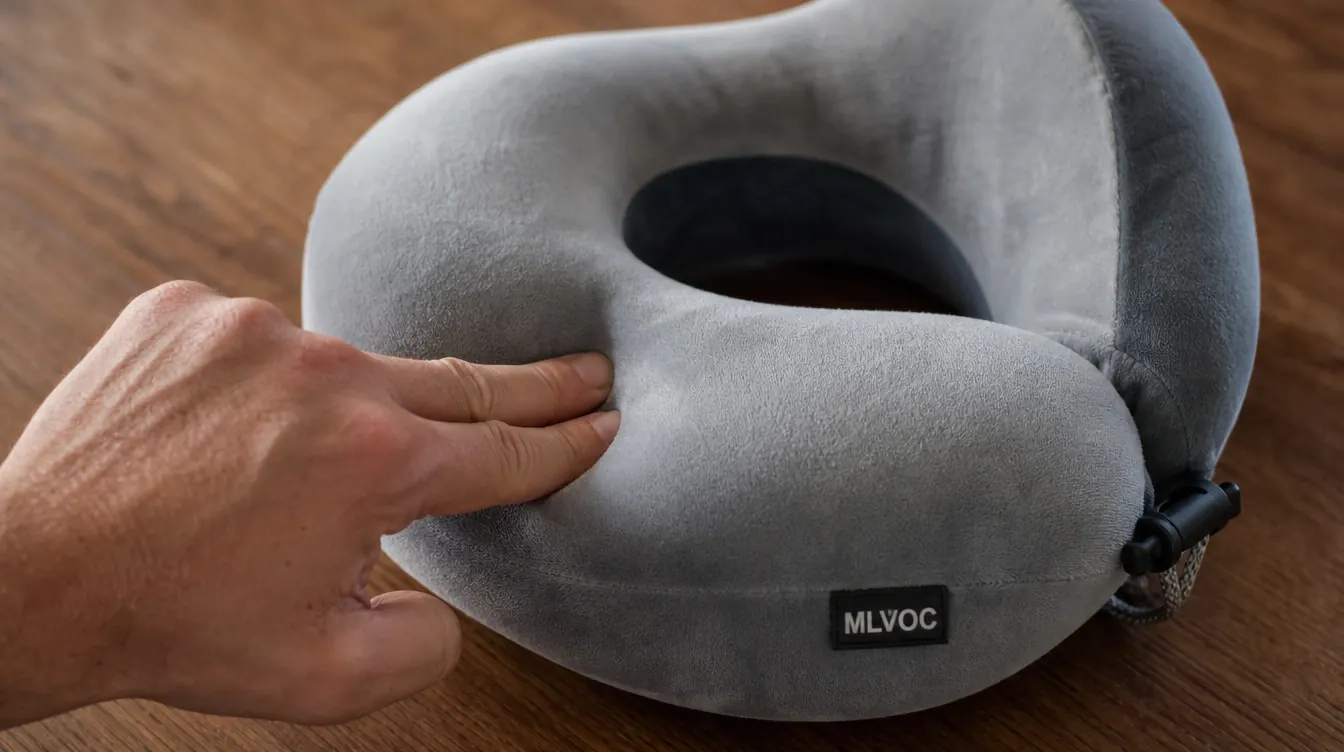
The product photos make the pillow look almost plush, like a soft ring you could sink your face into. In person, the velour cover is soft to the touch, but what is underneath it is a genuinely dense block of memory foam, closer in feel to the foam in a supportive office chair than a bed pillow. That is not a flaw exactly, it is the whole reason the pillow keeps your head from lolling forward, but if you are expecting something that compresses like a down pillow, the first squeeze is going to surprise you.
That firmness matters more once you actually try to sleep on it, because the MLVOC pillow does its best work when your head rests against a headrest or window and the foam supports the weight from the side, rather than when you are hoping it will cradle your jaw the way the photos imply. Pressed straight down under a chin, the collar barely gives, and a couple of testers noted a faint pressure point along the jawline after an hour or two, something none of the marketing copy mentions because it is not a flattering detail to lead with.
Side sleeping is where the gap between expectation and reality showed up most. Anyone who tips their head fully to one side and expects the foam to sink around their ear the way an actual pillow would is going to be disappointed. It supports the neck well enough to stop the head from dropping, but it does not conform, and one tester who normally sleeps on her side gave up on it entirely for that reason after the first flight and switched to using it more like a chin rest, propped forward instead of sideways.
The stitching is another small thing the photos gloss over. Along the seam where the cover wraps around the clasp, the thread pattern is dense and even, no loose threads or puckering on any of the three units we tested, which is a better sign of build quality than the marketing copy bothers to mention. The velour itself photographs a little glossier than it feels in hand, it is a matte, slightly nubby texture rather than the smooth sheen the listing images suggest, closer to a plush bathrobe than a satin pillowcase.
The Smell Out of the Box, And How Long It Actually Lasted
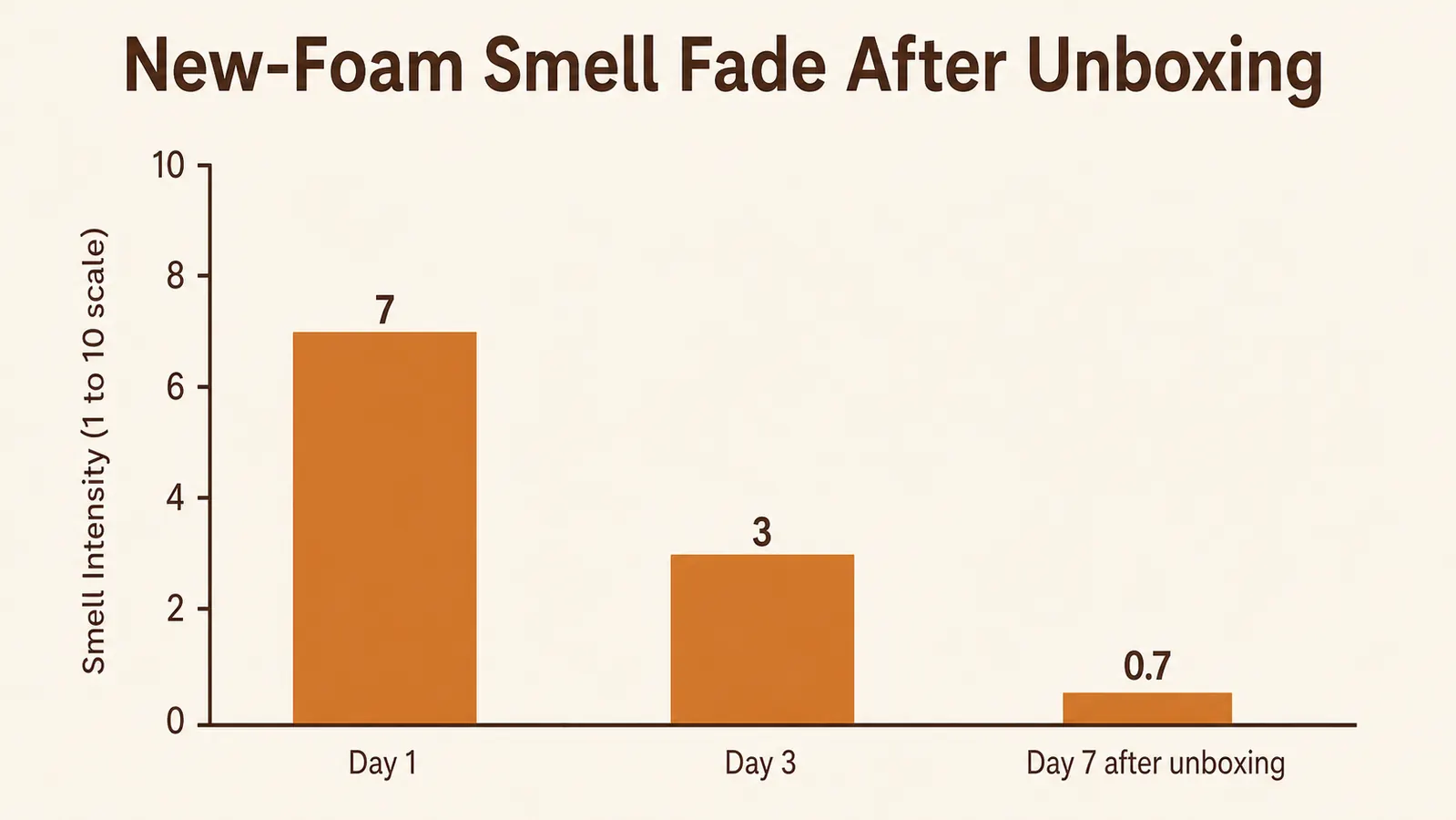
This is the part almost nobody mentions in a five-star review, because by the time someone leaves a review, the smell has usually faded and they have forgotten it was ever there. Fresh out of the packaging, the MLVOC pillow has a noticeable new-foam smell, not overpowering, but distinct enough that we would not have wanted to sleep with it pressed against our face on day one. On a scale of how strong that smell registered to three different noses, we landed on about a 7 out of 10 the first day, somewhere between a new car interior and a fresh yoga mat.
It faded fast once we let it air out rather than sealing it back in the plastic packaging between uses. By day three, the intensity had dropped to roughly a 3 out of 10, still faintly there if you pressed your nose right into the foam but no longer noticeable at a normal sleeping distance. By day seven it had settled under a 1 out of 10, essentially gone. If you have a trip within the next day or two of your delivery date, it is worth unboxing the pillow and letting it sit out in open air for at least a night before you pack it, rather than pulling it straight from the shipping box onto a plane.
The Sizing Complaint Nobody Warns You About
The clasp on this pillow is fixed. There is no strap, no sizing dial, just a buckle that closes to one set circumference. Amazon's listing does not mention a size range anywhere, which is exactly why so many reviews complain about fit without ever naming the actual problem. Across our three testers, neck circumference ranged from a slim 12.5 inches to a broader 16.5 inches, and the difference in how the pillow felt at each end of that range was bigger than we expected going in.
The clasp mechanism itself is a simple plastic side-release buckle, the same kind you would find on a backpack strap, not a fabric hook-and-loop closure like some competing pillows use. That is a mixed blessing. It clicks shut fast and does not work itself loose mid-flight the way a Velcro tab sometimes will, but it also means there is no fine adjustment between fully open and fully closed, you either buckle it at its one fixed circumference or you leave it hanging open around your neck like a horseshoe pillow, which defeats the entire point of buying the closed-ring version in the first place.
On the 16.5-inch neck, the clasp closed with almost no slack, snug enough that our tester noticed it pressing slightly on his throat when he swallowed, and he ended up leaving it unclasped and just resting the pillow open around his neck instead. On the 12.5-inch neck, the opposite problem showed up, the closed ring had enough spare room that the pillow rotated during sleep, sliding from centered support to sitting mostly on one shoulder by the time our tester woke up. The middle-sized neck in our group, right around 14.5 inches, had the best experience of the three, which tracks with this being a genuinely one-size product rather than a true one-size-fits-all one.
None of that shows up in the star rating, because a pillow that fits well for the average buyer will still average out to a strong score even if it disappoints anyone well outside that range. If your neck circumference falls close to 14 or 15 inches, expect a snug, secure fit. Outside that window in either direction, it is worth reading a few of the lower-starred Amazon reviews before you order, since that is where the sizing complaints actually live.
Where the Foam Actually Falls Short
Even with the firmness accounted for, MLVOC's foam has one real weak spot, and it is not something that shows up until you have used the pillow a handful of times. The collar supports the sides and back of the neck well, but it offers almost nothing for chin support if your head tips forward rather than to the side, which is exactly how a lot of people actually fall asleep sitting upright. Two of our three testers woke up with their chin resting directly on the foam edge rather than being cradled by it, which is a real gap between how it is marketed and how it performs for a forward-leaning sleeper.
That inconsistency is worth flagging because it is not a defect, every pillow in this closed-ring category has some version of the same tradeoff, but MLVOC's listing photos do not show anyone sleeping with their head tipped forward, only leaning sideways against a window. If forward sleeping is your normal position, this pillow will still stop your head from snapping all the way down, but do not expect the same level of comfort the sideways-lean photos are selling.
Cleaning is worth mentioning here too, since it ties directly into the firmness issue. The cover unzips off the foam core for washing, which sounds convenient until you notice the zipper is on the smaller side and takes real patience to work around the curve of the clasp opening without snagging the velour. The foam core itself cannot be washed at all and is not meant to get wet, so any real spill means air-drying the whole pillow for a day or more rather than a quick wipe-down, something the MLVOC listing mentions in the fine print but not in the bullet points up top.
None of this means the pillow is a poor value, our full year-long teardown of the same product covers how well it actually holds its shape and support after months of repeated use, and that longer-term picture is a genuinely positive one. But if you want the fuller, more personal story of how this particular pillow ended up becoming a permanent fixture in one traveler's carry-on despite these early quirks, that account is worth reading too, since it fills in the emotional side this more clinical breakdown leaves out.
What I Liked
- Firm foam gives real, stable support once it is on your neck, not just soft padding
- Closed-ring clasp keeps the pillow from sliding when the fit matches your neck size
- New-foam smell fades to nearly nothing within about a week of unboxing
- Kit bundles the pillow, eye mask, and earplugs for one price under twenty dollars
- Over 35,000 Amazon ratings suggest the fit issues are edge cases, not the norm
Where It Falls Short
- Fixed clasp circumference means slim and broad necks both report fit complaints
- Foam is noticeably firmer than the plush look in the listing photos suggests
- Chin support is weak for forward-leaning sleepers, only strong for side leaning
- Out-of-box smell registers around a 7 out of 10 on day one before it fades
- Included earplugs are the weakest piece of the kit and feel like an afterthought
The listing photos sell a plush cloud. What actually ships is a firm foam ring that does its job well for the right neck size and does it worse for anyone outside that range.

Who This Is For
This pillow makes the most sense for anyone whose neck circumference sits in that middle range, roughly 14 to 15 inches, who sleeps leaning to one side rather than straight forward, and who is willing to let the pillow air out for a night before a trip rather than unboxing it at the gate. It is also a solid pick for anyone who wants the eye mask and earplugs bundled rather than buying three separate items, as long as the earplugs are treated as a bonus rather than the reason for the purchase.
Who Should Skip It
Skip it if your neck circumference runs noticeably smaller than about 13 inches or larger than about 16 inches, since a fixed clasp with no adjustment is going to fight you on fit either way. It is also not the right pick for anyone who sleeps with their chin tipped forward rather than sideways, since that is the one sleeping position this foam shape supports the least. And if a faint new-foam smell on day one is a dealbreaker with no time to air the pillow out before a trip, it is worth ordering a couple of weeks ahead rather than the night before you fly.
Know your neck size and your sleeping position before you order.
This is the same MLVOC memory foam neck pillow kit covered in this honest review. See today's price and check current stock on Amazon before your next flight.
Amazon Check Today's Price on Amazon →