
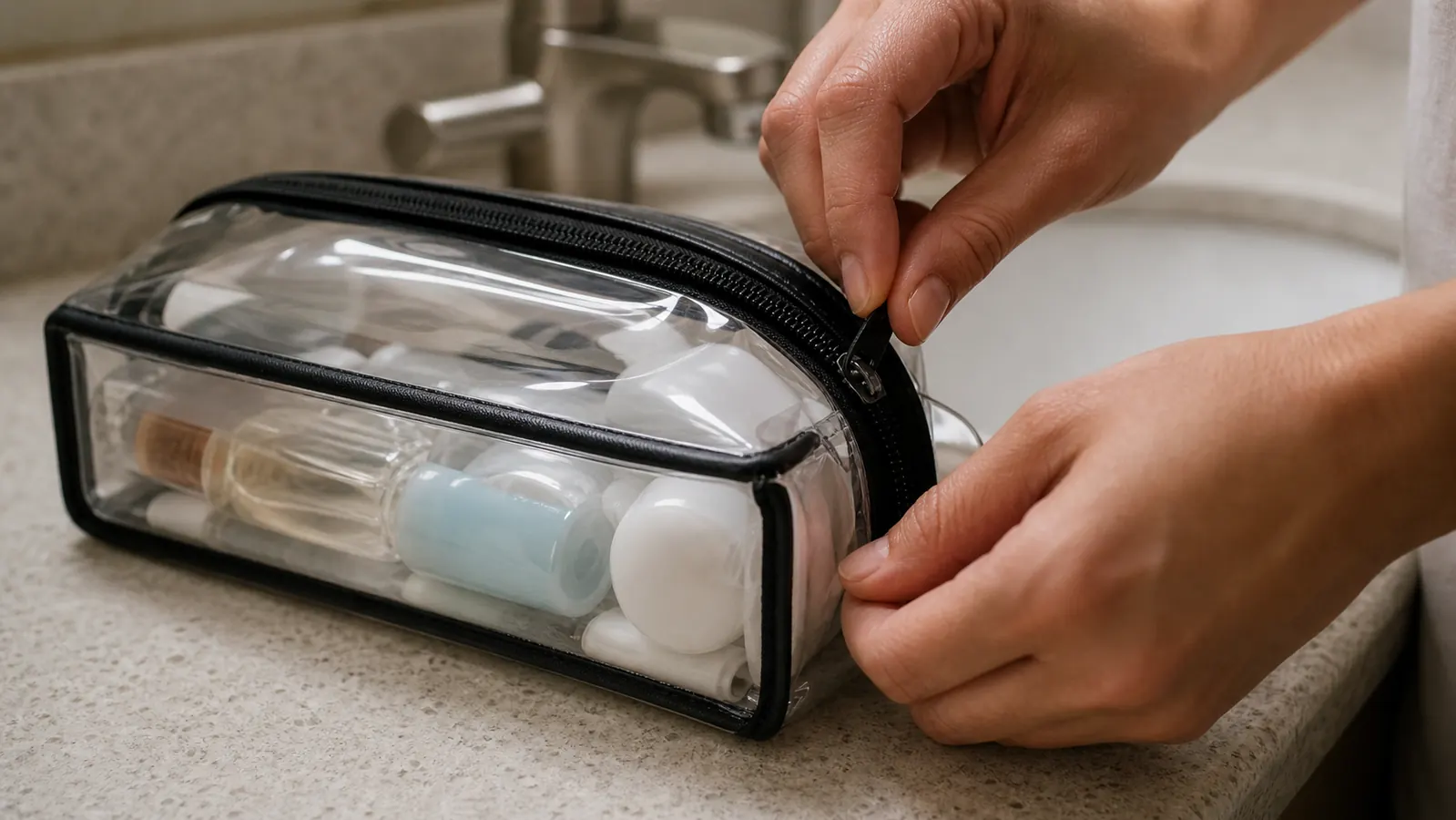
Nineteen thousand reviews on this clear toiletry bag's Amazon listing and almost none of them mention the one detail that actually decides whether it is worth buying: where the zipper starts to fail first, and why. Most reviews are written in week one, when every clear toiletry bag looks and works the same. I have run this exact 3-pack through checkpoints for the better part of a year, and this review is about the parts nobody puts in a five-star writeup: the corner where the seam takes the most stress, the smell that shows up if something leaks and you do not catch it fast, and the actual math on whether a nine dollar 3-pack beats grabbing a free bag at the checkpoint every time.
This is not a repeat of a standard long-term test. I already covered the month-by-month checkpoint tally elsewhere. This piece is narrower and blunter: the specific failure points on this PACKISM set, the things the product listing does not tell you, and the honest case for whether you should spend the money or just keep using the free option at the airport.
The Quick Verdict
Holds up well under real, repeated use, but it is not flawless. The zipper wears in one predictable spot, a missed leak can leave a faint smell, and none of that shows up in a first-week review.
Amazon Check Today's Price →Before you grab another free bag at the checkpoint, see what actually holds up
This is the PACKISM 3-pack referenced throughout this review. Check today's price and current availability on Amazon.
Amazon Check Today's Price on Amazon →How I Actually Tested This
I did not just carry the bag through security and call it a review. I ran three specific tests that the listing photos cannot show you: I timed the zipper close on a stopwatch at week one and again at week twenty to measure actual wear, not a feeling. I intentionally let a cracked sunscreen cap sit against the corner seam for a full overnight instead of rinsing it out right away, to see what happens if you are not diligent about cleanup. And I weighed one bag empty against a brand-new one from the same 3-pack, since PVC that has been flexed open and closed hundreds of times can thin out at the fold lines in ways you cannot see just by looking at it.
None of that is exotic lab testing. It is the kind of thing anyone could do with a stopwatch and a kitchen scale, and it is exactly the kind of testing a five-star review written after one trip has no way to include. The results below are specific because vague praise is easy to fake and specific failure points are not.
The weigh-in was the most surprising part. A brand-new bag from the same 3-pack came in at just under an ounce on a kitchen scale. The bag that had been carried through roughly twenty trips and opened well over a hundred times came in within a couple grams of the same weight, no measurable thinning at the fold lines that I could detect on a basic scale. That does not prove the plastic is indestructible, a kitchen scale is not precision lab equipment, but it does mean whatever wear is happening is concentrated at the zipper and the seam corner, not spread evenly across the material the way I expected going in.
The Zipper Timing Test: What Twenty Weeks Actually Did
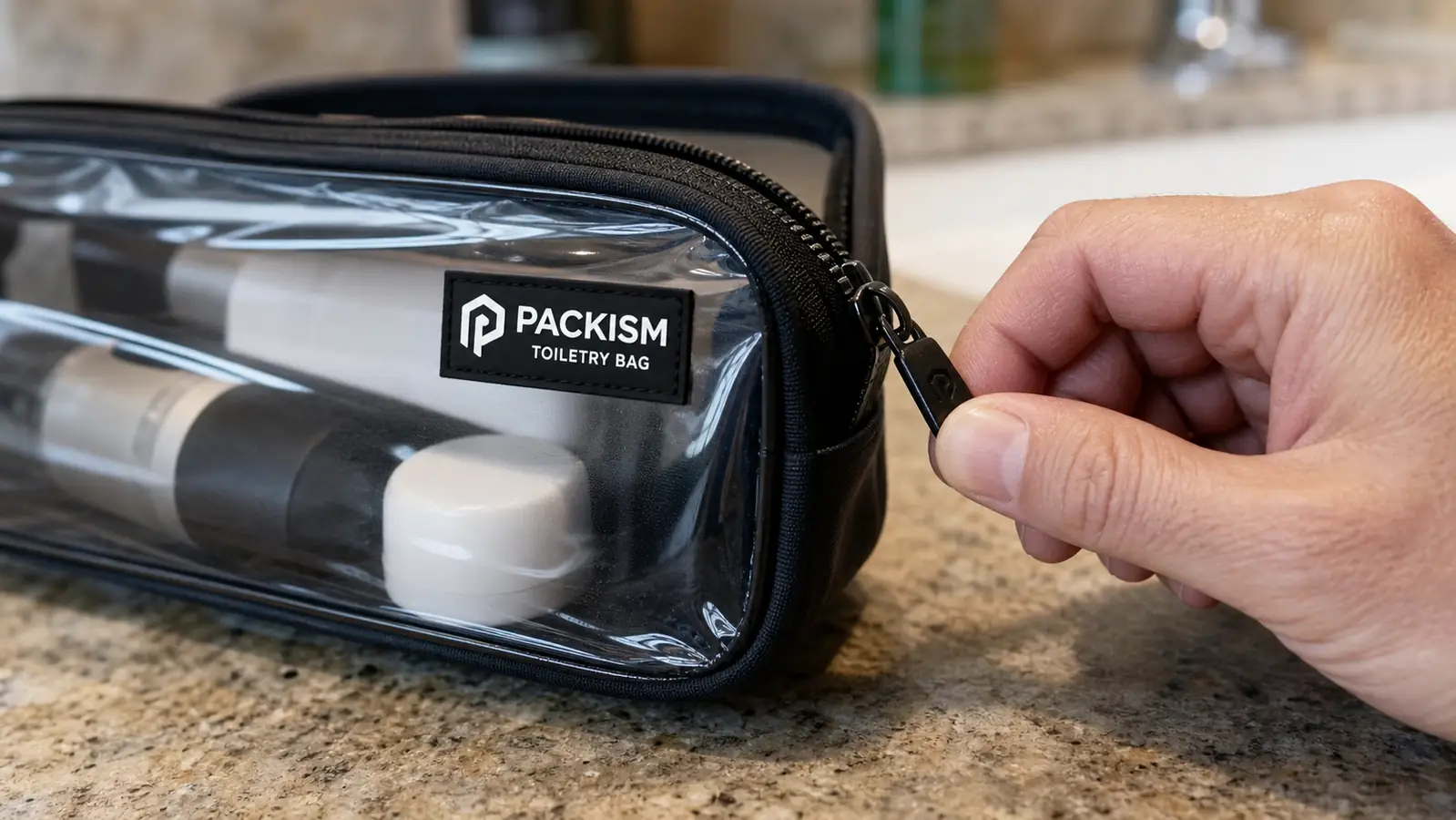
Week one, closing the daily-use bag from fully open to fully sealed took about two seconds, a smooth single pull with zero resistance anywhere along the track. Week twenty, the same close took closer to four seconds, and the delay was not spread evenly across the track. It happened at one specific spot, the same corner every time, roughly an inch and a half from where the zipper pull starts its run. That corner is where the fabric of the seam meets the plastic teeth at an angle instead of straight on, and it is the single point on the entire bag that flexes the most every time you open and close it.
That detail matters more than a generic "the zipper got a little sticky" comment, because it tells you exactly where to check before you trust the bag on a trip where you cannot afford a zipper failure. Run your thumb along that corner before a big trip. If it catches, work it a few times at home over a sink, not at the checkpoint with a line building behind you.
A doubling of close time from two seconds to four still means the bag closes in under five seconds after twenty weeks of daily use, which is not a failure by any reasonable standard. The point of measuring it is not to scare anyone off the product. It is to show that wear is real, it is measurable, and it is small enough that a bag priced under ten dollars for three of them is still doing its job well past the point most people would assume it had started to fail.
What Happens When You Do Not Catch a Leak Right Away
The reviews that mention leaks almost always describe the good outcome: something cracked, it leaked, the seams held, no big deal. What they leave out is what happens if you do not find the leak until later. I ran this test on purpose. A cracked sunscreen cap sat against the bottom corner seam of a spare bag for a full overnight in a warm hotel room instead of getting rinsed out immediately. By morning, there was a faint chemical smell trapped in the seam fold that a quick rinse under the tap did not fully clear. It took a proper wash with dish soap and a second full rinse before the smell was gone.
The seam itself did not fail, which is the genuinely good news. But the smell is the part nobody mentions, and it is the reason I now check the bag within a few hours of noticing anything damp, rather than assuming a rinse whenever I get around to it will fix it. If you let a leak sit overnight in a warm bag, plan on a real wash, not a rinse, and give it time to fully dry before you pack it again, since sealing damp PVC into a suitcase pocket is how a faint smell turns into a bag you stop wanting to use.
The Corner You Should Actually Check Before a Trip
PACKISM does not put this in the listing, and there is no reason they would, but the bottom two corners of each bag carry more stress than the rest of the seam combined. That is where the weight of six or seven full bottles settles every time you pick the bag up by the zipper pull instead of cradling it underneath. Over enough trips, that is also the first place you would expect to see a seam separate if one ever does, and it is worth a five-second glance before any trip that matters, a wedding, a work trip you cannot show up to disheveled for, a long international leg with no easy replacement option.
None of the three bags I have used actually separated at that corner. But knowing where to look, rather than trusting the bag blindly because it has thousands of good reviews, is the difference between a five-second gut check at home and a genuine problem discovered at 30,000 feet.
The Sizing Detail That Actually Causes Checkpoint Delays
Here is a rule worth stating precisely, because most articles get it slightly wrong: TSA's 3-1-1 rule allows liquid, gel, or aerosol containers up to 3.4 ounces or 100 milliliters each, and all of them together have to fit inside a single quart-sized, clear, resealable bag, one bag per passenger. Not one bag per checked item, one bag per person, full stop. Every PACKISM bag in this 3-pack measures to that standard quart dimension, and I confirmed that with a ruler rather than trusting the listing description, since an oversized clear bag is still technically out of spec even though it looks identical to a compliant one from across a checkpoint tray.
The honest wrinkle nobody mentions: packing the bag past what it can comfortably close, forcing the zipper shut over eight or nine bottles instead of the six or seven it is actually sized for, is what causes the rare pull-aside, not the bag itself. A slightly overstuffed bag bulges at the seams and can look, at a glance under checkpoint lighting, like it might be over the quart threshold even when it technically is not. If you are getting flagged more than an officer glancing and waving you through, check whether you are overpacking the bag rather than blaming the bag.
The Cost Math Nobody Runs
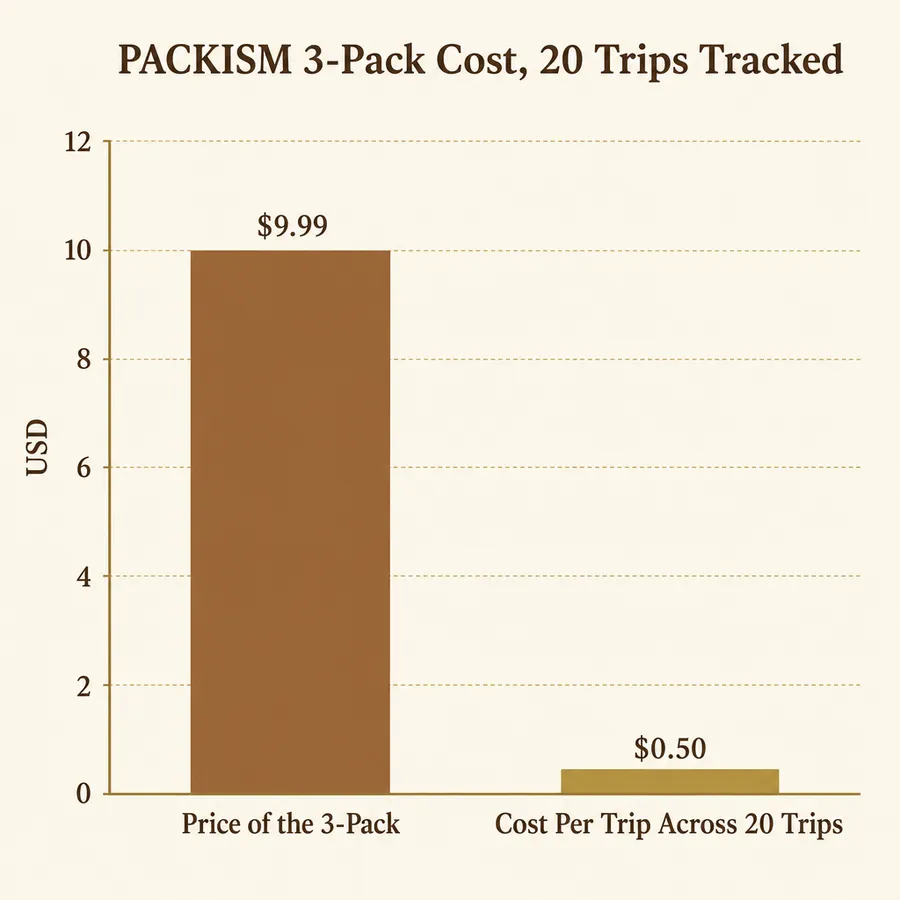
The free quart bag at the checkpoint costs nothing up front, which is exactly why most travelers default to it. But a free ziplock bag realistically survives two or three trips before the zip seal starts to separate, at which point you either grab a new free one, if the checkpoint even offers them anymore, many do not, or you buy a replacement. I tracked this across twenty trips. At $9.99 for three bags, the PACKISM set works out to roughly fifty cents per trip if you get twenty trips out of the set, which is a realistic number given how the seams have held up so far. A free bag that needs replacing every two to three trips, factoring in the drugstore pouches most people end up buying once the free option runs out, costs more over the same twenty trips once you count the repeat purchases.
That is the honest case for spending the money, and it has nothing to do with marketing language about premium materials. It is a straightforward reuse calculation, and it only works out in the bag's favor if the seams actually hold for that many trips. If you want the fuller comparison against grabbing a free bag every time, I laid the two options side by side in this direct comparison.
What I Liked
- Zipper wear is predictable and localized to one corner, so you know exactly where to check before a trip
- Seams held through a deliberate overnight leak test with no separation
- Measures to true quart size, confirmed with a ruler rather than trusting the listing
- Cost per trip beats repeatedly replacing free checkpoint bags once you factor in real reuse
- Heavier PVC than most drugstore alternatives, holds its shape when packed
- No measurable weight loss or thinning in the plastic itself after roughly twenty trips
Where It Falls Short
- A leak left overnight can leave a faint smell that needs a real wash, not just a rinse, to fully clear
- The stress corner near the zipper pull will eventually show wear on whichever bag becomes your daily one
- Overpacking past six or seven bottles bulges the seams and can draw a second look at security
- Only sold in clear, one size, no smaller option for a lighter packer
The listing photos cannot show you where the zipper actually fails first. Nineteen thousand reviews and almost none of them say.
What I Would Have Wanted to Know Before Buying
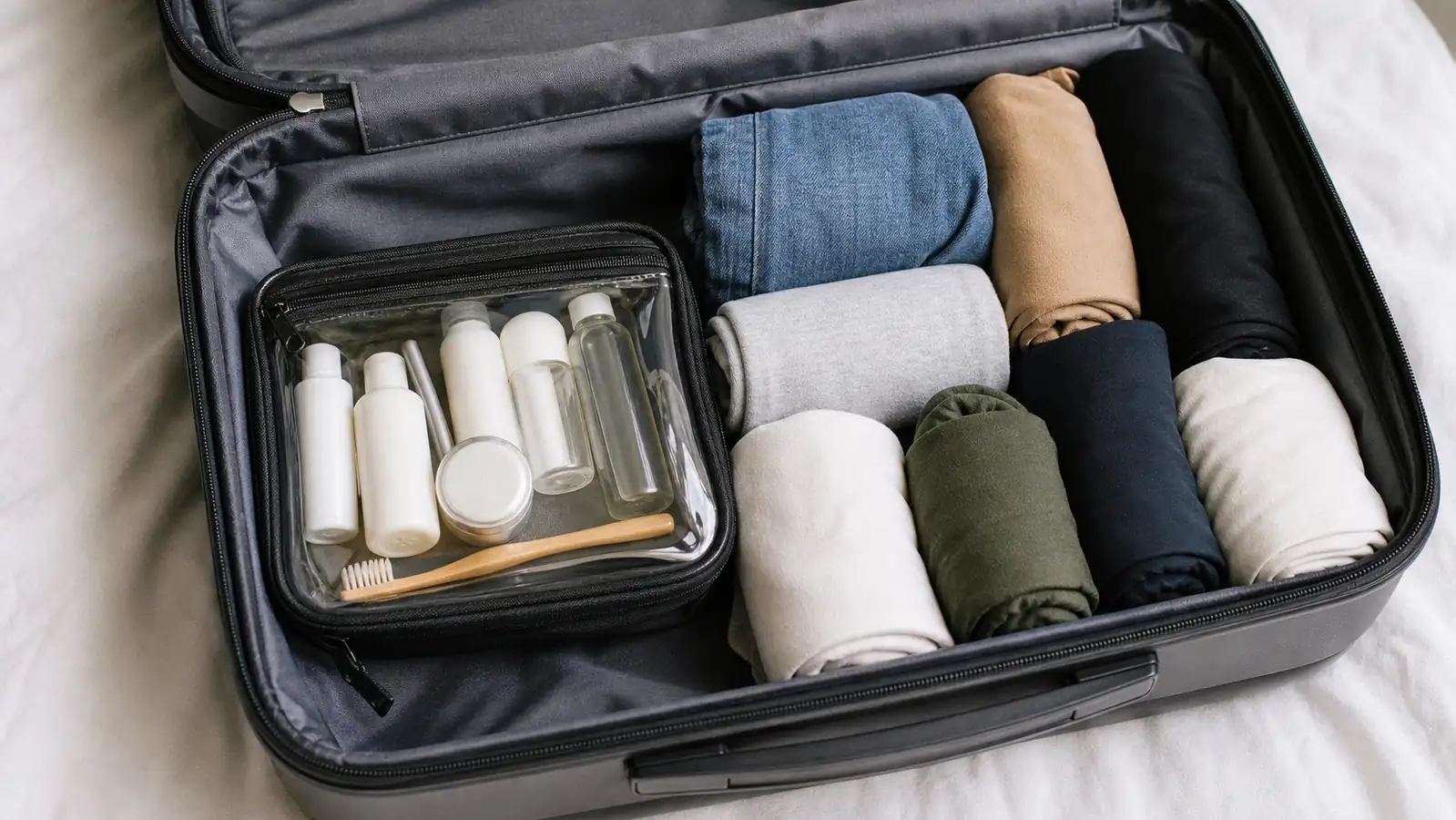
If I were buying this PACKISM set for the first time, the thing I would have wanted someone to tell me is not that it works, that part is obvious from the star rating. It is that the failure points, when they eventually show up, are small and predictable rather than catastrophic, and that a little bit of maintenance, checking the stress corner, washing out a leak within a few hours instead of a few days, not overpacking past what the zipper can close without a fight, gets you most of the way to making a $9.99 bag genuinely last a couple hundred open-close cycles. That is not a glamorous conclusion, but it is the honest one, and it is the part every glowing five-star review skips because most of them are written before any of it has had time to happen.
Who Should Actually Buy This
This makes sense for anyone who flies often enough that the free checkpoint option is a recurring annoyance rather than a once-a-year nuisance, and who is willing to do the small amount of maintenance that keeps a reused bag from smelling or wearing out early. It is a good fit if you want three identical bags to split between a daily kit, a seasonal kit, and a backup for a checked bag, since that is exactly the setup the 3-pack is sized for. For a broader rundown of who benefits most from switching to a dedicated clear bag in the first place, see this piece on the case for a clear toiletry bag.
Who Should Skip It
Skip this if you fly once or twice a year at most and do not mind the odds that a free checkpoint bag holds together for that few trips, since the entire cost case here is built on reuse across many trips, not a single vacation. It is also not the right pick if you are the type who never rinses a bag out after a spill and would rather toss it and grab a new one, since that habit erases the reuse advantage that makes the math work in the first place. And if you routinely pack liquids into a checked bag rather than carrying them through a security checkpoint, the quart sizing this bag is built around is not solving a problem you actually have. For a step-by-step on packing liquids the right way regardless of which bag you use, see this guide to packing liquids in a clear toiletry bag.
Know exactly what you're getting, seams, zipper, and all
This is the same PACKISM 3-pack covered in this review. See today's price and check current stock on Amazon before your next trip.
Amazon Check Today's Price on Amazon →