

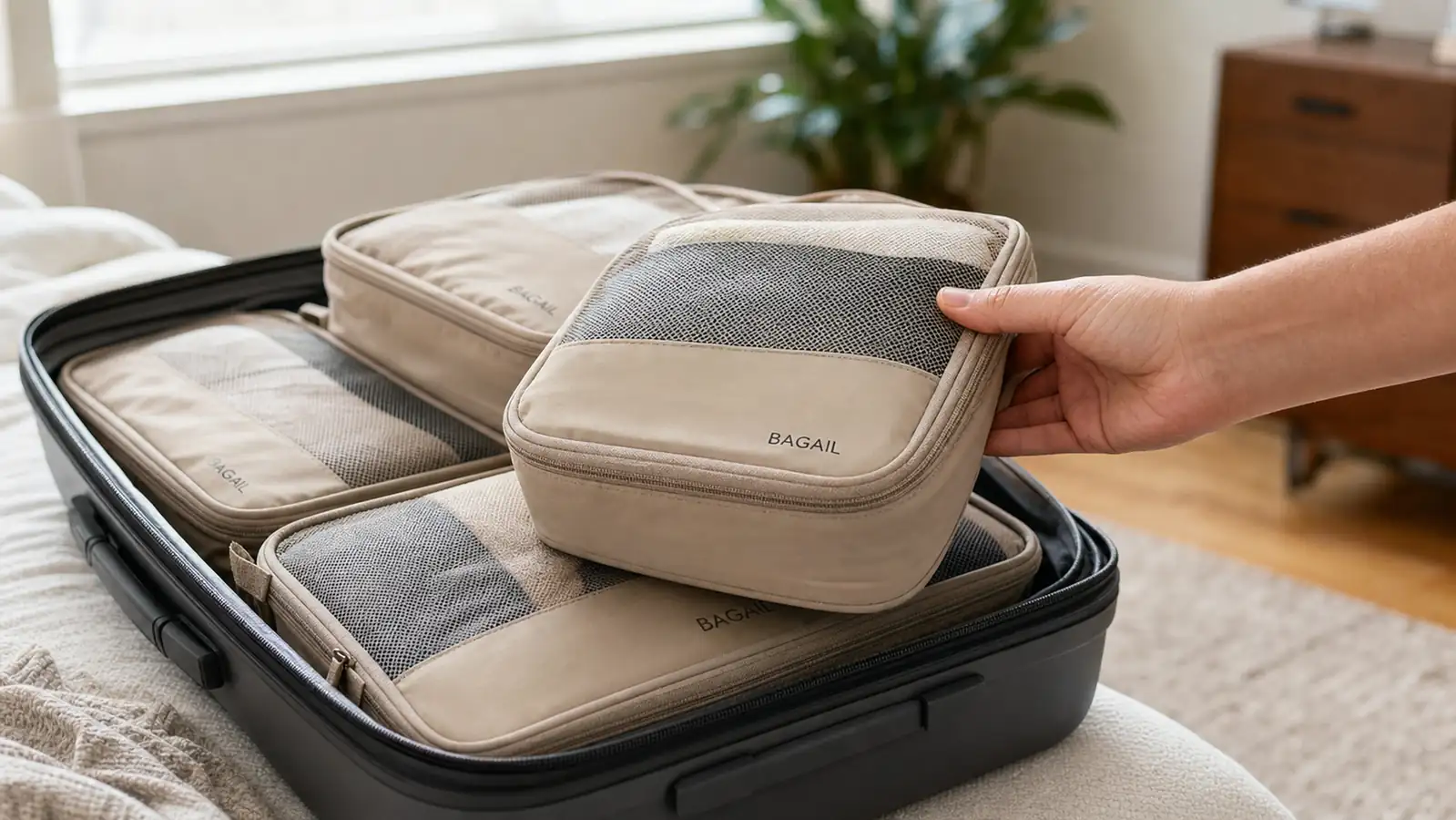
Every packing cube review says roughly the same three things: mesh top, sturdy zipper, fits a carry-on. What almost none of them say is what the set actually costs you over the two or three years you'll probably own it, because answering that requires owning one that long and doing the arithmetic instead of just describing the fabric. I've had this BAGAIL 8-piece set for fourteen months now, across sixteen real trips, and the question I get asked most isn't whether it works. It's whether it's worth the number on the box compared to a $12 no-name set from the same search results page, or a $60 set from a heritage travel brand two rows down.
That's a math question, not an opinion question, and almost nobody selling packing cubes wants to do the math out loud, because the answer depends entirely on how long the set survives, and admitting a product might fail early is bad for a five-star listing. I already wrote up the week-to-week performance of this exact set in a separate long-term test, BAGAIL packing cubes after eight months of monthly trips, so I won't repeat the zipper-by-zipper log here. This piece is narrower on purpose. I'm walking through the actual cost per trip, the wear points that show up outside the marketing photos, and the parts of a 4.6-star, 43,551-review rating that are worth reading past rather than taking at face value.
The Quick Verdict
The math holds up once you get past trip five or six. Before that, you're just hoping the set survives long enough for the cost-per-trip curve to matter.
Amazon Check Today's Price →Skip the guesswork and see today's price for yourself
This is the same 8-piece BAGAIL set we ran the cost-per-trip math on. Check today's price and current availability on Amazon before you commit to a set.
Amazon Check Today's Price on Amazon →How We Tested the Cost-Per-Trip Math
Fourteen months, sixteen trips: nine weekend trips close to home, three work trips that ran three or four nights each, and two longer international trips, a nine-day stretch in Costa Rica and a twelve-day trip through the UK where the same carry-on had to work without a laundry service for most of the middle week. That mix matters, because a set that only gets tested on easy weekend trips never gets stressed the way it does on a long haul where clothes get crammed back in wrinkled and half-clean.
I tracked four things trip by trip: whether anything needed replacing, what a comparable replacement piece would actually cost if I had to buy one separately, how much extra time the wear points added to packing or unpacking, and whether the set still looked and functioned close enough to new that I'd hand it to a friend without apologizing for it. That last one is a gut check most reviews skip entirely, and it turns out to be a pretty honest measure of whether something held its value.
I'm not going to pretend this is a lab test. It's one set, used the way a normal person actually uses packing cubes, which is inconsistently, sometimes stuffed too full, occasionally left in a damp gym bag for two days after a trip because unpacking felt like a chore. If a set can't survive normal human laziness, the cost-per-trip math falls apart no matter how good the marketing copy sounds. I also weighed the set on a kitchen scale before and after the UK trip, curious whether the mesh and zippers were adding meaningful bulk to a carry-on that already runs close to the airline limit, and the full eight pieces together landed under two pounds empty, light enough that it never factored into a single weigh-in at the gate.
The Number on the Box vs the Number That Matters
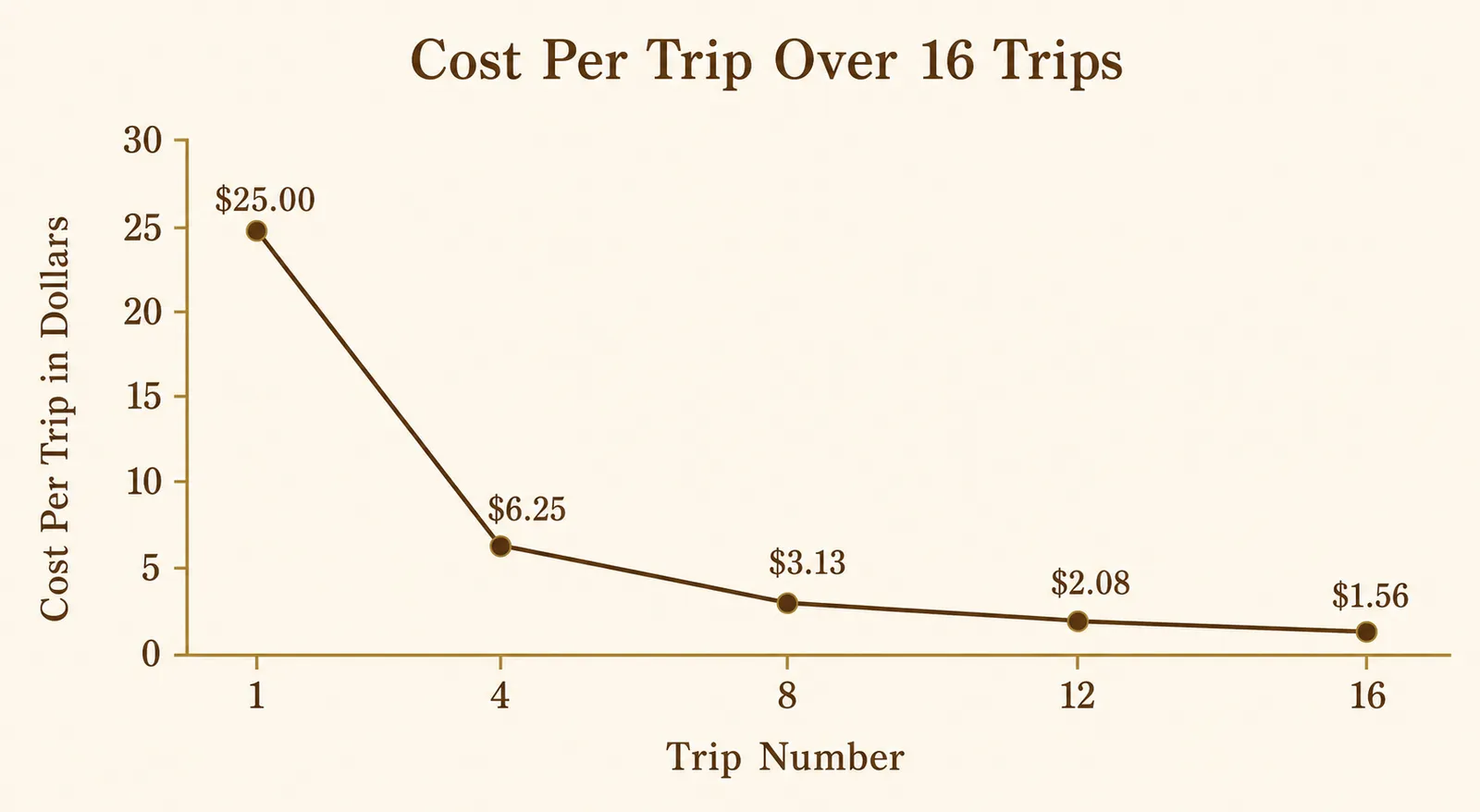
The sticker price on a set like this sits right around $25 for eight pieces, and on its own that number means almost nothing. A $25 set that falls apart on trip three cost you more per use than a $60 set still going strong on trip thirty. A $12 set that lasts exactly one trip before a seam splits was never actually cheap, it just moved the cost from your first purchase to your second, third, and fourth replacement purchase, each one adding shipping time and a hassle factor that never shows up in the price comparison.
So here's the actual math, using today's price as the baseline and round numbers for clarity. Call it $25 total for the set. On trip one, that's $25 per trip, obviously a bad deal in isolation. By trip four, assuming nothing needed replacing, you're down to $6.25 per trip. By trip eight it's $3.13. By trip twelve it's $2.08. By trip sixteen, where this set currently sits, it's $1.56 per trip, and every additional trip from here keeps pushing that number down as long as the set keeps functioning.
That curve is the entire argument for buying a mid-tier set instead of the cheapest option on the page, but it only works if the set survives long enough to ride the curve down. A set that dies at trip three never gets past roughly $8 per trip, which is worse value than paying more upfront for something that lasts. This is the part nobody puts in a bullet point, because it requires admitting that price and value are two different measurements, and most listings would rather you just look at the smaller number and check out.
What 43,551 Reviews Actually Tell You (and What They Don't)
A rating with over forty thousand reviews feels like it should settle the question, and in one sense it does. It tells you the failure rate on arrival is low, that most buyers get a set that works as described, and that BAGAIL isn't running some kind of bait-and-switch operation where the product photos don't match what ships. That part is genuinely useful and worth taking seriously before you write off a large review count as meaningless.
What it doesn't tell you is anything about month ten, month twelve, or trip sixteen, because the overwhelming majority of reviews get written in the first few weeks after a purchase, when everything still smells new and every zipper still glides. A four and a half star average built mostly on first-impression reviews is measuring a different thing than a cost-per-trip breakdown is measuring. First impressions are about whether the product matches its listing. Long-term value is about whether it's still doing its job a year later, and almost nobody goes back and edits their review to reflect that.
I went looking through the review section for anyone reporting on long-term use past six months, and they exist, but they're a small fraction of the total, buried under a much larger stack of unpack-and-photograph reviews written the same week the box arrived. That's not a knock on BAGAIL specifically, it's just how review sections work for almost every product on Amazon. If you want the honest long-term picture, you have to go find people who actually kept using the thing, which is the entire point of a review like this one.
The Wear Points Nobody Mentions in the Five-Star Reviews
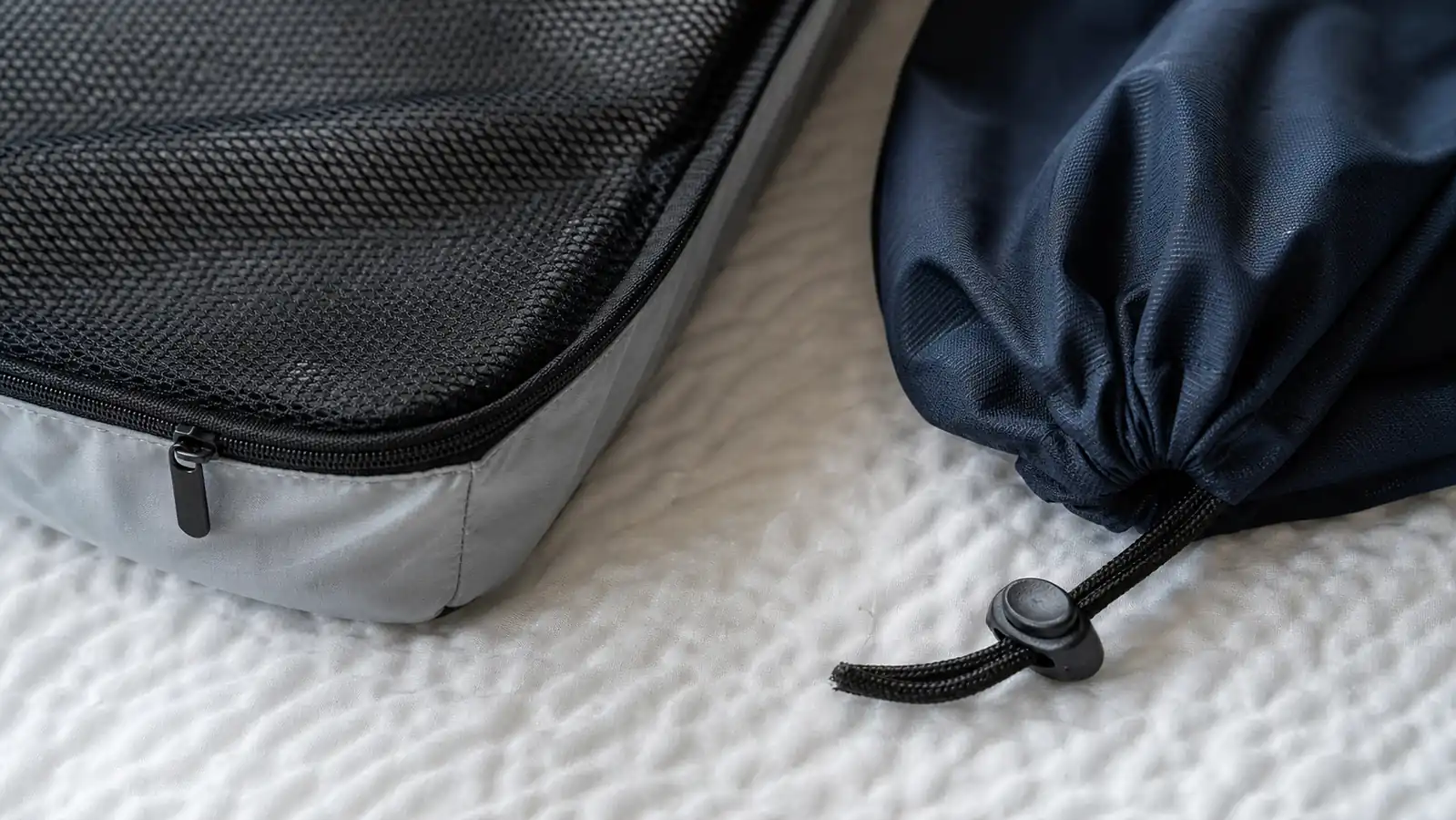
Around trip ten, the drawstring toggle on the laundry-style bag started sliding looser than it used to, to the point where I had to cinch it twice to get it to actually stay closed. It still works, it's just no longer a one-pull motion the way it was out of the box. Nobody mentions this in the early reviews because a toggle cord doesn't loosen in the first three weeks. It takes months of repeated cinching and releasing to show up at all, which is exactly why it's invisible in a rating built on first impressions.
Around trip thirteen, the piping along one corner of a large cube, the one that carries the most volume on nearly every trip, started to separate slightly from the main panel. It's a couple of millimeters, cosmetic rather than structural, and the cube still zips and holds its shape fine. But it's the first visible sign of age on the set, and it's worth knowing about before you buy rather than discovering it yourself a year in and wondering if you got a bad unit.
The thread along one zipper pull on a small cube has also started to fray slightly, the kind of thing you only notice if you run a thumb over it. It hasn't affected function at all. I'm including it anyway because the honest version of a cost-per-trip review has to log the small stuff too, not just the failures dramatic enough to make a headline. None of these three things have cost me a single trip's worth of use so far, but they're the first data points suggesting where this particular set will eventually need retiring, probably somewhere past the two-year mark at the current pace.
So What Does a Trip Actually Cost?
At sixteen trips in with nothing actually needing replacement, this BAGAIL set is sitting at roughly $1.56 per trip and dropping. Even if I'm generous about how much life the drawstring toggle and the corner piping have left, and assume the set needs full replacement somewhere around trip thirty, the lifetime cost still lands under a dollar per trip. That's a genuinely good number for something that keeps a carry-on organized and cuts unpacking time down to a couple of minutes at each stop.
Compare that to a $12 set that historically fails within the first two or three trips for a lot of buyers, based on the return and complaint patterns you can find if you actually read the one and two star reviews on cheaper competitors instead of skipping past them. A set like that never gets below roughly $4 to $6 per trip before it needs replacing, which means the supposedly cheaper option ends up costing more per use than the mid-tier set that survives. I wrote more about this exact trap, buying cheap and paying for it later, in a separate piece about why I finally stopped buying the cheapest packing cubes on the shelf, if you want the fuller story behind why this math changed how I shop for travel gear in general.
On the other end, a $60 premium set from a heritage brand has to survive a lot longer to catch up to where this set already sits. If it lasts twice as long, roughly thirty-two trips, it's still only matching this BAGAIL set's current cost-per-trip number, not beating it. For most travelers doing a mix of weekend trips and the occasional longer haul, that math doesn't justify the premium unless durability is the only thing you're optimizing for and price genuinely doesn't matter to you. Even buying replacement pieces individually, one large cube or one small cube at a time if a single piece ever does fail outright, costs less than most people assume once you've already gotten a dozen or more trips out of the original set.
What I Liked
- Cost per trip has dropped to roughly $1.56 and keeps falling with continued use
- No functional failures across 16 trips over 14 months, only minor cosmetic wear
- The 43,551-review sample confirms low arrival-defect risk, which is worth something on its own
- Mesh tops keep packing and unpacking fast, which is a real time cost savings over loose packing
- 8 pieces cover clothes, small items, and laundry separation without buying anything extra
Where It Falls Short
- The drawstring toggle on the laundry bag has loosened and now needs cinching twice
- Corner piping on the most-used large cube has started to separate slightly by trip 13
- A zipper pull thread on one small cube is fraying, cosmetic so far but worth watching
- The bulk of Amazon reviews reflect first-impression use, not the long-term picture this review covers
- Cost-per-trip math only works out if the set actually survives past the first few trips
A cheap set isn't cheap if it fails at trip three. It just moves the cost to your next purchase and hides it there.
Who This Is For
This math favors anyone who travels often enough to actually ride the cost-per-trip curve down, roughly six or more trips a year, and who cares more about the real long-term number than the sticker price on day one. It's also the right fit if you've been burned before by a cheap set that failed early and cost you more in replacements than a mid-tier set would have cost upfront. If you're the kind of traveler who keeps gear for years rather than replacing it every season, this BAGAIL set is built for that math to work in your favor.
Who Should Skip It
If you take one trip a year, the cost-per-trip math never gets favorable enough to matter, and a couple of individual cubes will serve you better than a full 8-piece set that mostly sits in a closet. Skip it too if you want the absolute heaviest-duty construction money can buy regardless of price, since a premium set will likely outlast this one even if the per-trip math takes longer to catch up. And if a slightly loosening drawstring or a couple millimeters of corner wear after a year would genuinely bother you, that's fair to know going in rather than finding out after your own set starts showing the same small signs.
Ready to run the math on your own trips?
This is the same 8-piece BAGAIL set behind every number in this review. See today's price and current stock on Amazon before your next trip.
Amazon Check Today's Price on Amazon →