

I started carrying a portable charger years ago after watching my phone die in a security line with my boarding pass still loaded on the lock screen. Since then I have cycled through four different power banks, two that quit working within a year and one that got flagged at a security checkpoint in a country with battery-size rules I had not bothered to check ahead of time. This is the one that finally stuck. I bought this 10,000mAh, 45W charger in February, right before a stretch of six months that ended up including eleven flights, two long train rides through Europe, and enough hotel-room charging routines that I stopped thinking about the process and just started trusting it would work when I plugged it in.
Six months and roughly fifty recharge cycles later, I am still using the same unit and the same cable, and I have not had a single trip where it left me stranded. This review covers the INIU 45W Fast Charging Portable Charger after real travel use, not the first week out of the box when every power bank feels perfect. If you have been burned before by a charger that shipped full of promises and quietly died at the six-month mark, or by one so bulky it never actually made it out of the junk drawer, this is the failure window I paid attention to. Does the battery still hold a real charge, does the 45W output still deliver, and does the size make sense to pack every single time.
The Quick Verdict
A dense little 10,000mAh, 45W charger that has earned a permanent spot in my carry-on after six months of near-daily use. Measurable capacity fade by month six, but it still delivers well over two full phone charges and the housing has not shown a single crack.
Amazon Check Today's Price →Tired of watching your phone die at 40% before you even reach the gate?
This is the exact INIU 10,000mAh, 45W charger from this review. Check today's price and current availability on Amazon before your next trip.
Amazon Check Today's Price on Amazon →How I've Used It
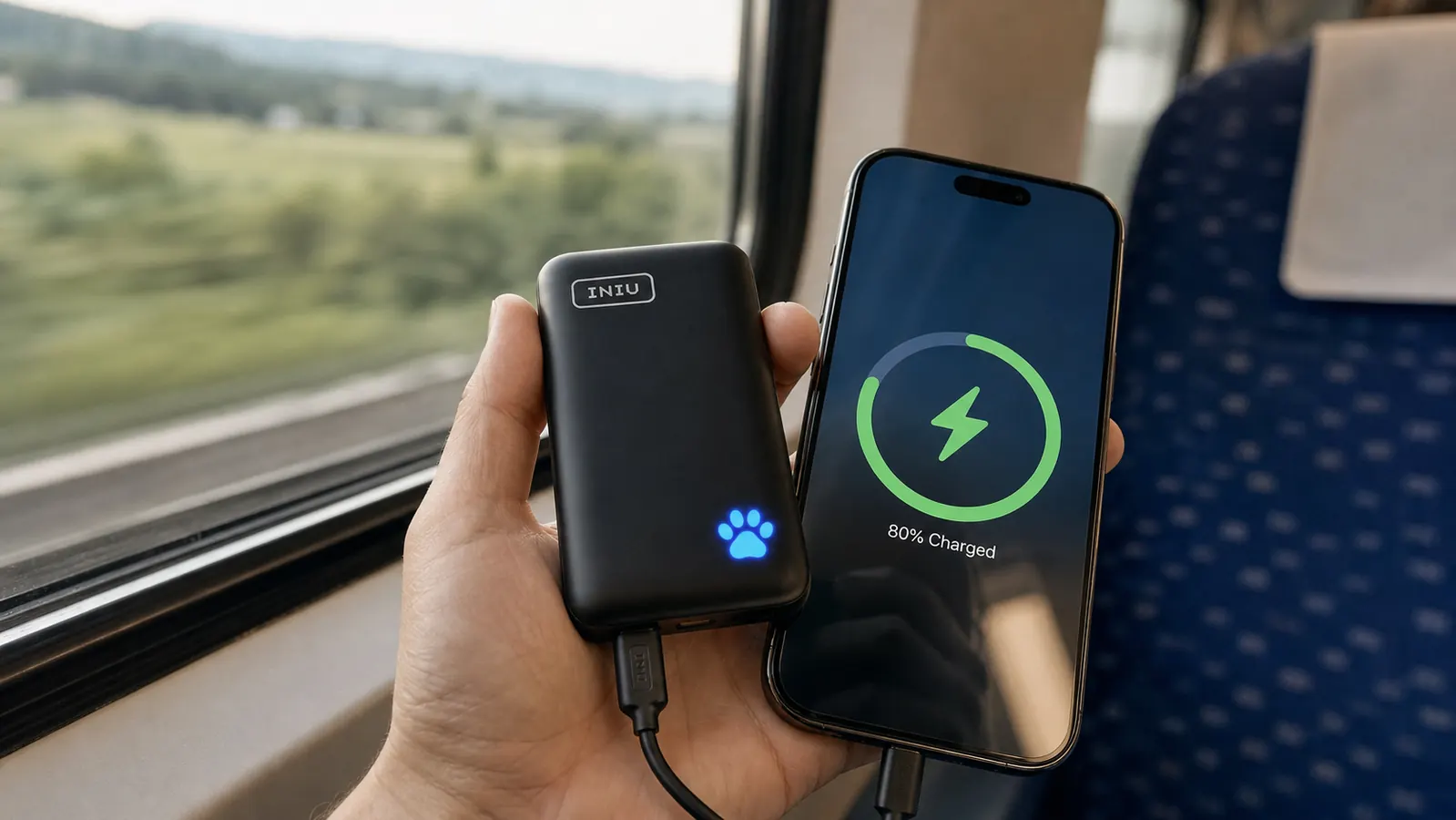
The routine I settled into with the INIU charger is almost embarrassingly simple: top it off to full the night before any travel day, drop it in the outer pocket of my backpack where I can reach it without unzipping anything, and plug in the moment my phone drops below 50%. At 7.9 ounces and roughly the footprint of a deck of cards stacked three high, it disappears into a bag in a way my old 20,000mAh brick never did. That size difference matters more than it sounds like it should when you are the one carrying it through a terminal for the eleventh time in six months.
The real test came on an eleven day trip through Portugal and Spain in April, where I relied on it for a phone doing double duty as a boarding pass, a translation app, offline maps, and a camera. A redeye from Denver to Reykjavik in June was the other stress test, seven hours with no outlet at my seat and a phone I needed charged enough to find ground transportation on arrival. In both cases the charger did exactly what it was supposed to do without me thinking about it twice, which is the highest compliment I can give a piece of gear that only matters when it fails.
I also used it to top off a pair of wireless earbuds and, once, to give a travel companion's dying phone enough charge to call a ride. None of that is unusual for a power bank this size, but it is worth saying plainly: a single 10,000mAh unit at 45W is not meant to be your only charging solution for a multi-day trip with no outlets at all. It is meant to bridge the gaps, a long layover, a red-eye, a day of sightseeing with no charger in sight, and on that job it has not once come up short.
Battery Capacity and What It Actually Delivers
Ten thousand milliamp hours sounds like a lot until you convert it into what actually leaves the port. Between the voltage step-up from the battery's native 3.7 volts to a phone's 5 volts, and the normal conversion losses every power bank has, you lose somewhere around 15 to 20 percent of that rated capacity before it ever reaches your device. In practice that meant the INIU delivered close to 2.4 full charges for an iPhone with a roughly 3,300mAh battery when I first tested it in February, and closer to 1.7 full charges on a travel companion's Galaxy S23 Ultra, which carries a larger 5,000mAh battery. Neither number is a flaw. It is just physics, and it is the same math every 10,000mAh charger on the market is working with, INIU included.
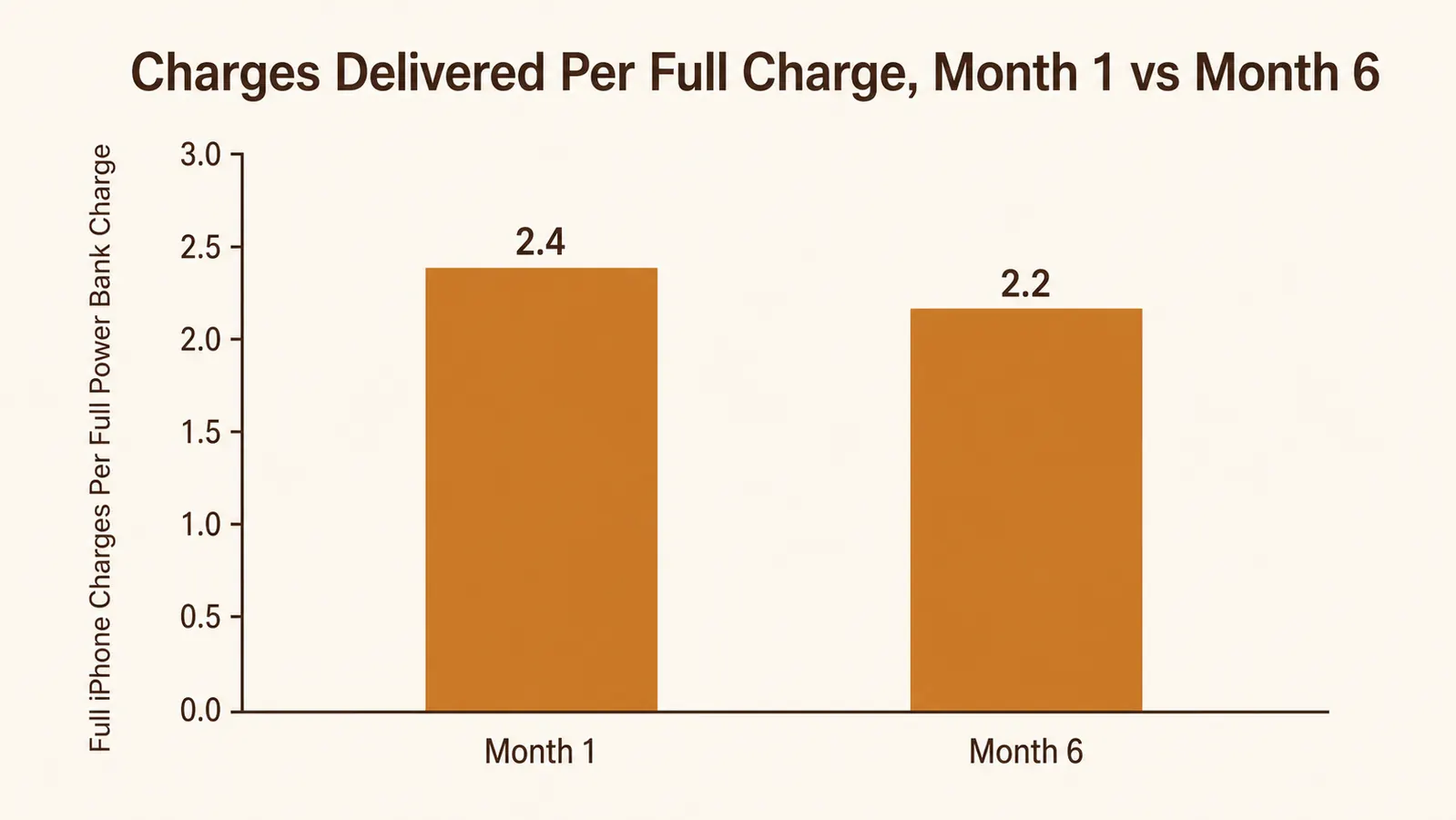
What I wanted to know after six months was whether that number would hold. I ran the same test in August that I ran in February: charge the power bank to 100%, then use it to charge the same iPhone from empty until the bank's LED display hit zero, tracking how many full phone charges it delivered. In February it averaged 2.4 charges. In August, after roughly fifty recharge cycles of daily travel use, it averaged 2.2 charges, a real but modest drop of about eight percent. That is consistent with normal lithium-ion capacity fade over a few dozen cycles, and it is nowhere near the cliff-edge failure I have seen from cheaper banks that lose a third of their capacity in the same window.
There is a practical side benefit to the 10,000mAh size that has nothing to do with fade: it clears the 100 watt-hour carry-on limit with room to spare. At 3.7 volts nominal, 10,000mAh works out to 37 watt-hours, well under the TSA threshold, and the rating is printed right on the housing so a gate agent or security officer never has to take my word for it. I have flown internationally with it six separate times in six months and never once had it questioned, which is more than I can say for the 20,000mAh unit I used to carry.
45W Charging Speed, Real World
The 45W rating is a peak number, not a constant one, and it is worth being clear about what that means before you buy expecting laptop-speed charging out of a device this size. Using the USB-C to USB-C cable it ships with, I timed a phone charge from 20% to 80% at nine minutes in February and nine and a half minutes in August, a difference small enough that I would call it noise rather than a real slowdown. That speed only shows up with a phone and cable that both support USB-C Power Delivery at a reasonable wattage. Plug in an older phone over USB-A, and you will get standard fast-charge speeds instead, still useful, just not the headline number.
I also tested it against a USB-C laptop that supports lower-wattage charging, and it will hold a laptop's battery level roughly steady during light use rather than charging it quickly from empty, which tracks with what a 45W output can realistically do against a laptop battery several times the size of this power bank. If your plan involves fully charging a laptop from a dead battery on a flight, this is not that device, and no charger this size honestly is.
The cable matters more than most people expect. I tested the same charging session with a cheap third-party USB-C cable I had in a drawer and lost nearly three minutes off the 20-to-80 window, purely from cable resistance. If you buy this charger, use the cable it comes with, or at minimum a cable rated for the wattage you actually want, or you will end up blaming the power bank for a bottleneck that is sitting in your cable bag instead.
How It Held Up Over 6 Months
The housing on this INIU charger is a matte, slightly textured plastic that has resisted the scuffs and scratches I expected after six months of getting tossed into a backpack alongside keys, a phone, and whatever else lives in that pocket. There is one small scuff on a corner from a drop onto a hotel bathroom tile floor in Madrid, a fall from about three feet that I fully expected to crack something. It did not. The corners are slightly rounded rather than sharp, which I suspect is exactly why that drop did not do more damage.
The LED percentage display on the front, rather than the old four-dot indicator most power banks still use, has stayed accurate the entire time I have owned it. I cross-checked it against my own charge-count testing in February and again in August, and the displayed percentage matched the actual remaining output within a few points both times. That sounds like a small thing until you have owned a charger with a display that lies to you, showing 50% when the unit dies two minutes later.
The only real wear point after six months is the USB-C input port, which has developed a very slight wobble when the cable is plugged in, noticeable if I go looking for it but never enough to interrupt a charge or cause a loose connection. It still charges reliably every time, and I would call this cosmetic rather than functional at this point, but it is the one component I am watching most closely heading into month seven and beyond.
INIU vs What I Considered
Before landing on this INIU charger, I seriously considered a comparable 10,000mAh unit from Anker, a brand with a longer reputation in the charging space and, in my experience with an older Anker bank, similarly solid build quality. I put together a full side-by-side breakdown of specs, output, and six months of real use in this INIU versus Anker PowerCore comparison if you want the direct numbers rather than my general impression here, but the short version is that the two are closer in real-world performance than the price gap between them would suggest.
I also weighed going bigger, a 20,000mAh bank that would deliver roughly double the charges per top-off. I ended up back at 10,000mAh for the same reason I landed on this specific charger: the weight and the TSA-friendly watt-hour rating matter more to me on a trip than squeezing out one extra phone charge before I need to plug in again. If you are still deciding whether a portable charger belongs in your bag at all, here are ten reasons a portable charger is worth buying that walk through the case in more detail than fits in this review.
What I Liked
- Delivered 2.4 full iPhone charges when new and still delivers 2.2 after roughly 50 recharge cycles over 6 months
- 45W USB-C output charged a phone from 20% to 80% in about 9 minutes, both in month 1 and month 6
- 37 watt-hour rating clears the TSA 100Wh carry-on limit with room to spare and has never been questioned
- Survived a 3-foot drop onto tile with only a small cosmetic scuff
- LED percentage display has stayed accurate the entire 6-month test
- 7.9 ounces and pocket-sized, small enough that I actually carry it every trip
Where It Falls Short
- About 8% measurable capacity fade after 6 months of near-daily recharge cycles
- USB-C input port has developed a slight wobble, cosmetic so far but worth watching
- 45W will not fast-charge a laptop from empty, only hold a light-use laptop roughly steady
- Charging speed drops noticeably with a cheap third-party cable instead of the included one
- A single charge is a bridge for one to two devices, not a multi-day solution with zero outlets
Ten thousand milliamp hours never meant ten thousand milliamp hours reaching my phone. What matters is that six months later, the real number has barely moved.
Who This Is For
This charger makes the most sense for someone who travels often enough that a dead phone at the gate is a recurring problem, not a once-a-year inconvenience, and who wants a power bank small enough to actually carry rather than one that sits in a suitcase pocket unused. It suits anyone flying internationally who wants a watt-hour rating printed clearly enough to clear security without a conversation, and anyone who has been burned by a bank that lied about its remaining charge right when they needed it most. If your travel days involve a phone doing the work of a boarding pass, a map, and a camera all at once, this is a straightforward yes.
Who Should Skip It
Skip this one if your real need is charging a laptop from empty on a long flight, since 45W is not enough wattage to do that quickly and you will be better served by a larger, heavier bank built for that job specifically. It is also not the right pick if you are heading somewhere with genuinely zero outlets for several days straight, since a single 10,000mAh charge is meant to bridge gaps between outlets, not replace them entirely. And if you rarely let your phone drop below 30% in a normal day, you may be solving a problem you do not actually have, in which case the money is better spent elsewhere in your travel kit.
Ready to stop rationing your phone battery through a long travel day?
This is the same INIU 10,000mAh, 45W charger that delivered over two full phone charges every month of this six-month review. See today's price and check current stock on Amazon.
Amazon Check Today's Price on Amazon →