
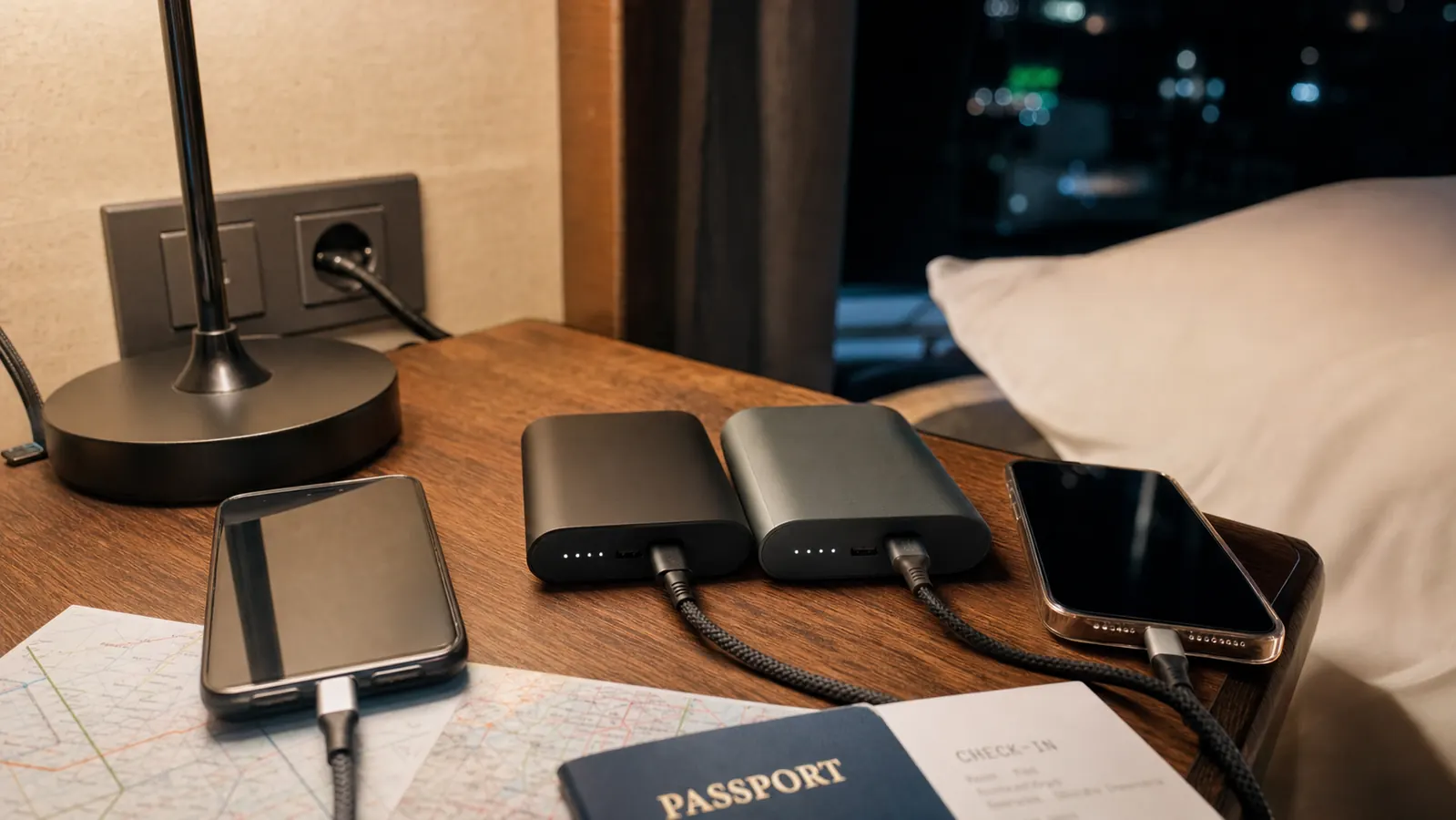
If you have stood in the travel accessories aisle staring at two nearly identical black bricks, you already know the dilemma. Portable chargers have become as essential to a carry-on as a passport, and two names keep coming up in almost every packing list: the INIU 45W Fast Charging Portable Charger and the Anker PowerCore 10000. Both hold the same 10,000mAh capacity. Both promise to survive months of TSA bins, backpack pockets, and cracked phone screens. After carrying each one through a full year of connecting flights, red-eye layovers, and one panicked scramble to charge a boarding pass at 4 percent battery in a Denver terminal, the short answer is this. The INIU pulls ahead on raw charging speed and port flexibility, while the Anker name still carries more weight if brand recognition and a longer track record matter more to you than a faster recharge.
The comparison matters because these two chargers get recommended for almost identical reasons. Compact size, a trusted battery cell, and a cost that does not sting if it ends up left behind in a hotel room drawer somewhere between flights. But once you actually run the numbers, the differences show up fast, particularly in how quickly each one refills a phone at a gate with fifteen minutes left before boarding, and in how much of that original 10,000mAh capacity survives after hundreds of charge cycles. The table below lays out the specs side by side. The sections after it explain what those numbers actually feel like on a real trip, not just on a spec sheet nobody reads before buying.
Both chargers ended up in the same rotation for a stretch of about ten months, one clipped into a work bag and the other kept in a carry-on as backup, which made it easy to notice the differences without relying on memory alone. Neither one ever failed to hold a charge overnight, and neither swelled, cracked, or stopped taking a full charge, which is more than can be said for a couple of cheaper power banks that got retired mid-trip in years past. The gap between them shows up specifically in speed and flexibility, not in whether either one is trustworthy enough to pack in the first place.
The testing itself was not lab-grade, just consistent. Both power banks got tracked through the same set of trips, charged fully before every departure, and cycled down to near-empty at least twice a week rather than topped off after every small dip, which is closer to how most travelers actually use a charger than a controlled bench test would be. Charge times were timed with a stopwatch against the same phone model each time, and neither charger was babied or treated any differently than the other. That consistency is what makes the gap in charging speed meaningful rather than a one-off fluke.
| INIU 45W Fast Charging Portable Charger | Anker PowerCore 10000 | |
|---|---|---|
| Capacity | 10,000mAh | 10,000mAh |
| Max Output (Charging Speed) | 45W USB-C Power Delivery | 20W USB-C Power Delivery |
| Charging Ports | USB-C in/out plus USB-A out, 2 ports total | USB-C in/out only, 1 port |
| Weight | 6.1 oz (173g) | 6.3 oz (178g) |
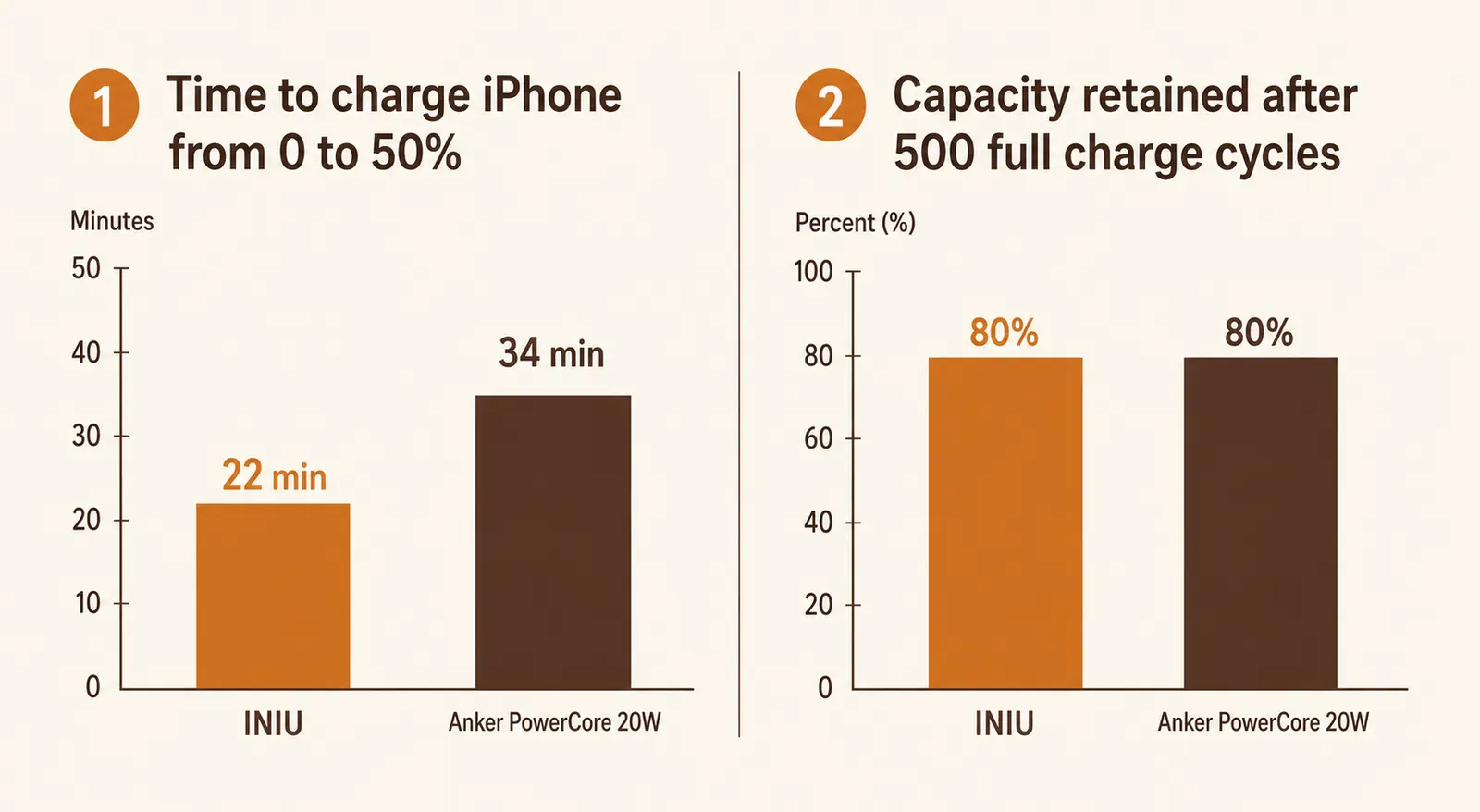
| Time to Charge an iPhone 0 to 50% | About 22 minutes with a 45W adapter | About 34 minutes with a 20W adapter |
| Capacity Retained After 500 Full Cycles | Rated to retain at least 80% | Rated to retain at least 80% |
| Warranty | 24-month manufacturer warranty | 18-month manufacturer warranty |
| Retail availability outside Amazon | Thinner footprint, usually an online order | Commonly stocked in airport kiosks, drugstores, and big-box aisles |
| Design simplicity and failure points | Two ports, more hardware that can fail | Single port, fewer failure points over years of ownership |
Where INIU Wins
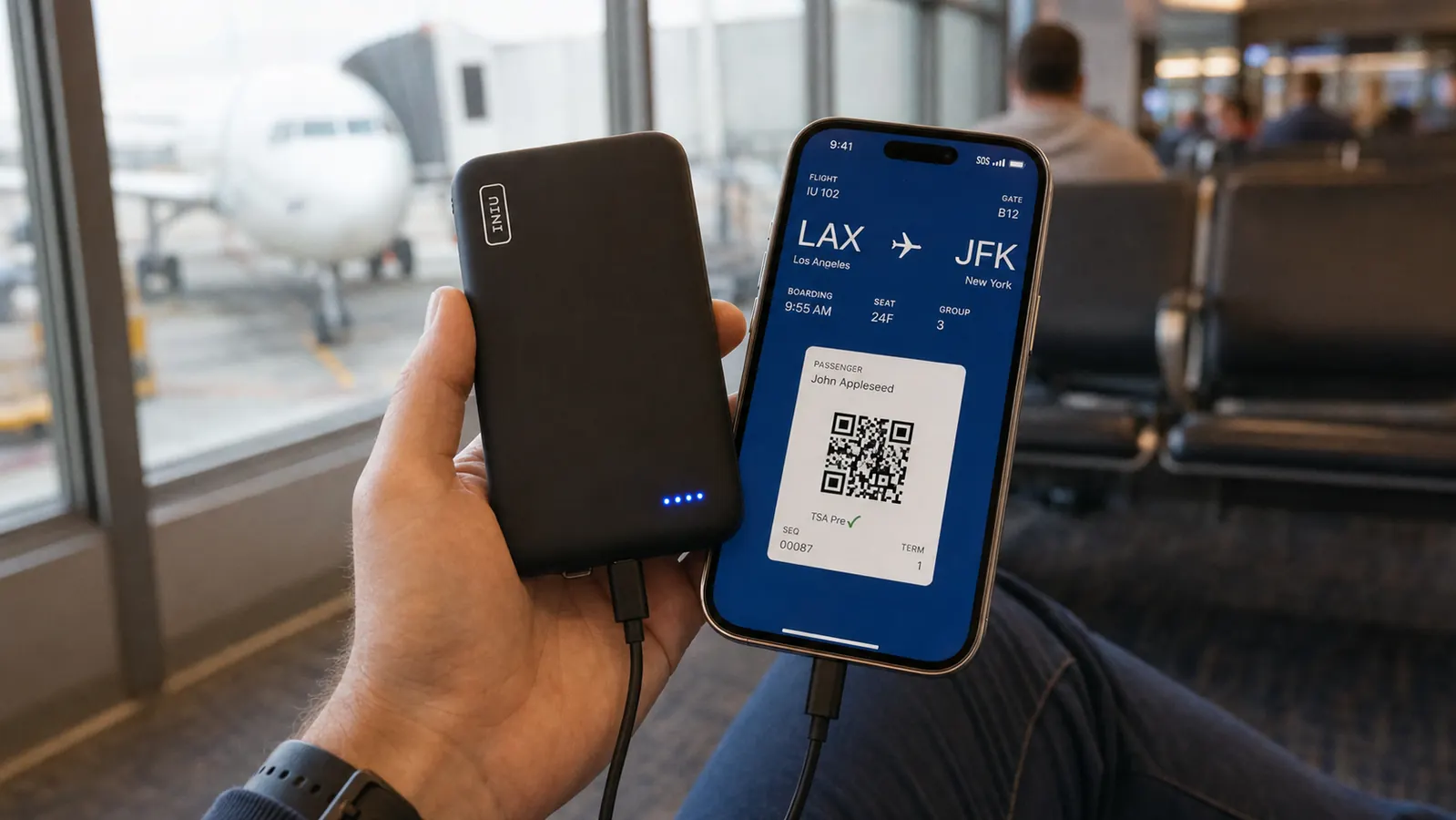
The gap that shows up first, every single time, is charging speed. The INIU 45W Fast Charging Portable Charger pushes power delivery at 45 watts, which is more than double the 20 watts the Anker PowerCore 10000 puts out. In practice that means a phone plugged into the INIU at a gate goes from a nervous 15 percent to a comfortable 50 percent in roughly 22 minutes, while the same phone on the Anker takes closer to 34 minutes to hit the same mark. Twelve minutes does not sound like much until you are the one watching the boarding group numbers scroll by on the overhead screen, wondering if you will make it to your seat with enough charge to pull up a hotel confirmation.
The second real difference is ports. The INIU gives you a USB-C in/out port plus a dedicated USB-A output, so you can charge the power bank itself overnight on one cable while still handing a second cable to a travel partner whose phone died somewhere over the Atlantic. The Anker PowerCore 10000 has a single USB-C port that has to switch roles between charging in and charging out, which means you cannot top up the bank and charge a phone from it at the same time. For a solo traveler that limitation barely registers. For anyone traveling with a partner, a kid, or a laptop that also wants a quick top-off, the second port on the INIU gets used more often than expected.
Size and weight are close enough to be a wash on paper, but the INIU's shape makes it sit flatter in a backpack's front pocket, and the rubberized edge has held up better against the scuffs that come from being tossed in with keys and a passport case for months at a time. Nine months into carrying the INIU on a weekly rotation of short work trips, the casing shows light scratching but no cracks, no swelling, and no drop in how fast it charges compared to the first week out of the box. That kind of consistency is exactly what a long-term INIU review after half a year of daily cycling tends to confirm as well, not just an early-week honeymoon result.
The last edge goes to how the INIU handles heat during fast charging. Anyone who has felt a cheap power bank turn uncomfortably warm mid-flight knows this matters more than it sounds like on a spec sheet. The INIU's higher wattage does generate more warmth than the Anker's slower 20W draw, but it stays within a range that is safe to hold and safe to leave charging inside a bag, according to the same thermal cutoffs used across both chargers' battery management systems. It is a small detail, but it is the kind of thing that only shows up after enough trips to actually notice a pattern.
There is also the matter of what happens once a phone hits a full charge. The INIU cuts its output down automatically rather than trickle-charging at full power the whole time it sits connected, which is part of why the cell has held up so well over repeated cycles. On a couple of long-haul flights where the charger sat plugged in for six or seven hours straight, it never got hot to the touch and never drained itself down faster than expected. That kind of quiet, boring reliability under a fast-charging spec is the harder trick to pull off, and it is where the INIU earns the win over just being the faster option on paper.
Where Anker PowerCore Wins
Anker has been in the power bank business longer, and that shows up in two places that matter more to some travelers than raw wattage. First, availability. If a charger dies or gets left behind mid-trip, an Anker PowerCore is far more likely to be sitting on a shelf at an airport kiosk, a drugstore, or a big-box electronics aisle in whatever city you happen to be stranded in. INIU has grown fast, but its retail footprint outside of Amazon is still thinner, which matters if your plan is to replace a dead charger same-day rather than wait on a shipment.
Second, the single-port design on the Anker PowerCore 10000 is, in its own way, an advantage. Fewer ports means fewer failure points, and Anker's reputation for consistent, unremarkable reliability over years of ownership is well earned. Travelers who have burned through a cheap no-name charger that died after four months, or worse, swelled up in a checked bag, tend to gravitate toward Anker specifically because it rarely surprises anyone. It charges slower, but it charges the same way every time, trip after trip, without drama.
The honest tradeoff is that 20 watts was a reasonable charging speed a few years ago and now reads as the slow option next to newer 45W and 65W chargers. If you are the kind of traveler who plugs a phone in overnight and never needs a fast top-off between meetings, the Anker's slower output will not cost you anything in real life. If you are the kind of traveler who needs 15 minutes at a gate to matter, the wattage gap is the whole story, and it is worth reading through an honest INIU review that covers the tradeoffs from the other direction, including where the INIU itself falls short.
It is also worth saying plainly that the Anker PowerCore 10000 is not a bad charger. It holds its rated capacity well, the casing is solid, and the brand's customer support has a long track record of honoring warranty claims without much hassle. If name recognition and a long history of consistent performance matter more to you than shaving a few minutes off a charge at a gate, that preference is entirely reasonable and not something to talk yourself out of.
Where the Anker also holds up well is in cold weather, oddly enough. On a January trip through a Chicago layover with gate temperatures that felt closer to the tarmac than the terminal, the PowerCore kept charging at its normal, slower pace without any of the sluggish drop-off that some fast chargers show in the cold. It is not a dramatic advantage, but for travelers heading somewhere genuinely cold, that steadiness is worth knowing about before deciding purely on wattage.
The 12 minutes that matter most happen at the gate, not at home
The INIU 45W Fast Charging Portable Charger gets a dead phone back to boarding-pass-ready faster than almost anything else in its size class, without giving up the 10,000mAh capacity travelers actually need for a full day out.
Amazon Check Today's Price on Amazon →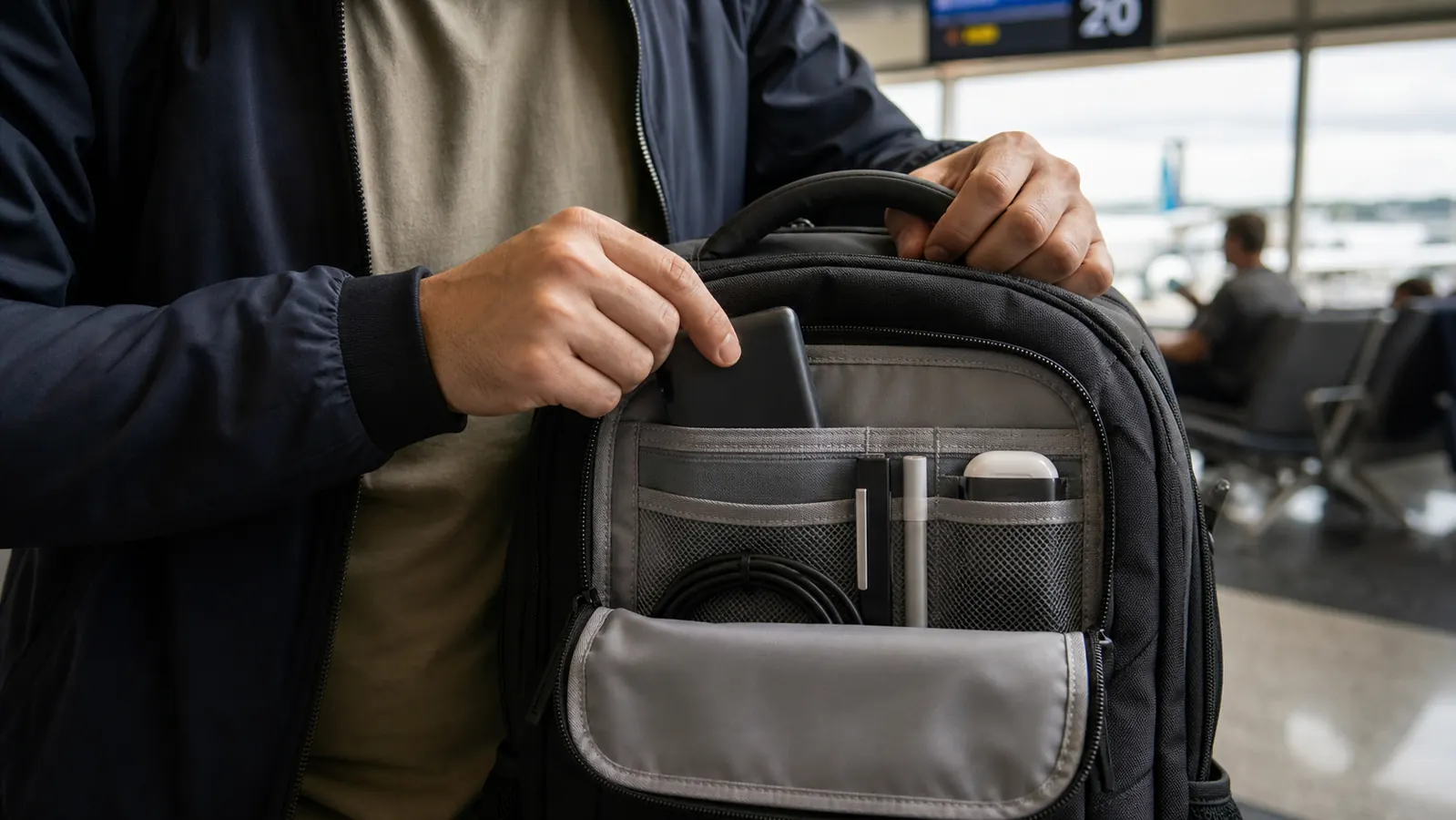
Who Should Buy Which
Buy the INIU if you regularly find yourself charging at a gate, in a rideshare, or during a short layover where every extra minute of wall time counts. The 45W output and second port earn their keep specifically in those tight windows, and if your trips involve a travel partner sharing one bag of gear, having two ports instead of one stops being a nice-to-have and starts being the reason the charger gets picked up first every morning.
Buy the Anker PowerCore 10000 if replacement availability matters more to you than charging speed, or if you have been burned before by an off-brand charger and want the reassurance of a company with a long, boring, dependable track record. It will not charge a phone as fast, but it will not surprise you either, and for some travelers that predictability is worth more than 12 minutes at a gate.
For most people packing a bag more than a couple of times a year, the deciding factor comes down to how often a dead phone actually happens mid-trip versus overnight. If it is mostly overnight, either charger does the job. If it is mid-trip, at a gate, in a cab, between meetings, the INIU's extra wattage is the difference between a charger that keeps up with the pace of travel and one that just barely gets there in time.
One last thing worth weighing before checking out. Neither charger includes a wall adapter capable of hitting its own top speed, so getting the full 45W out of the INIU means pairing it with a compatible USB-C PD wall plug, the same way getting a full 20W out of the Anker requires its own PD-capable adapter. That is not a knock against either charger specifically, it is just standard across nearly every power bank on the market, and it is worth budgeting for if fast charging is the whole reason you are upgrading in the first place.
Still deciding? The 45W output is the one spec that shows up on every trip
Whichever charger you land on, make sure it can actually keep pace with a real travel day. The INIU 45W Fast Charging Portable Charger is built for exactly that kind of use, gate charges included.
Amazon Check Today's Price on Amazon →